Thursday, March 14, 2013

Market Basket, a Pasadena institution since 1930, two locations on North Lake Avenue

Once upon a time there was a local Pasadena supermarket chain called Market Basket.....

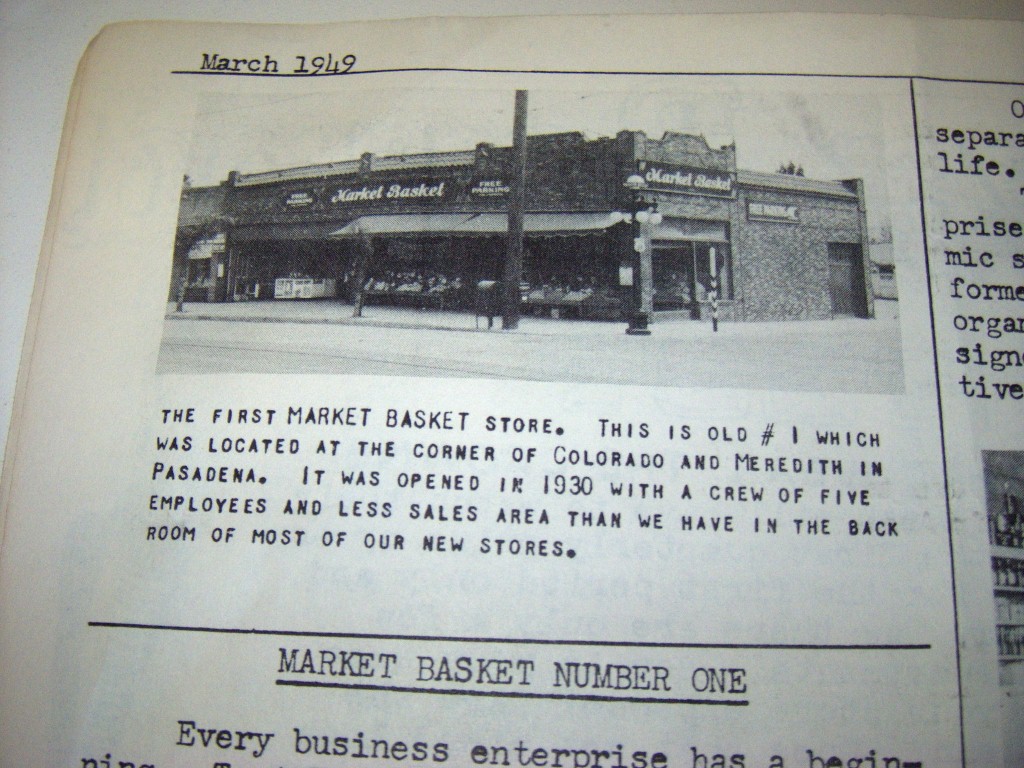
Market Basket News, Volume 1, Number 3, March 1949
 Store Number 1, Old Number 1, was located at Colorado and Meredith in 1930 

 New Store Number 1, located at the middle of the block of Colorado between Bonnie and Meridith on Colorado, was opened the evening of February 17, 1934, just a few doors away from Old Number 1.  Now the 99 Cents Only Store occupies the space at 1720 E. Colorado.
 Here a closer view of Old Number 1 located on the SE corner of Colorado and Meridith, just a little to the east of the New Number 1.
 Here a picture of the interior of Old Number 1 in April, 1930
 Why the customers love their local Market Basket!
Market Basket was a local Pasadena chain of markets which existed up into at least the 1980's, as the Food 4 Less located in Lake Washington Village was originally named Market Basket, after the Kroger Company acquired the rights to the name and built what was called at first in 1986 the North Lake Market Basket Center.  A year or two later, Kroger renamed the Market Basket store and the center the Food 4 Less supermarket and center and changed the marketing concept.  It's been rather downhill since then.....

Across the street at 1260 North Lake, where Big Lots is now located, was our historic Market Basket, going out of business in the late 1970's, with the building becoming Continental Catering until it became Pic 'n' Save in the 1980's, later with a name change to Big Lots in 2002.

Here is a picture of the 1260 North Lake Market Basket in the early 1950's, when the Space Patrol rocket showed up during a promotion for Rice Chex breakfast cereal.
Here is some more information about the Market Basket chain and part of our lost heritage of a local business which disappeared: http://pleasantfamilyshopping.blogspot.com/2007/08/market-basket-mayhem.html

 http://www.flickr.com/photos/toomuchfire/4786163527/

http://www.groceteria.com/board/viewtopic.php?t=698

As of 1959, these Market Basket locations are listed in the Pasadena area:
2270 N. Lake Avenue, Altadena
2502 N. Fair Oaks, Altadena
1160 N. Fair Oaks, Pasadena
40 N. Santa Anita, Pasadena
1859 E. Washington, Pasadena
1280 N. Lake Avenue, Pasadena

We've come a long way.......  Our other local institution, Pronto Market aka Trader Joe's is not bad, though!  http://avenuetotheskylakeavenuepasadena.blogspot.com/2010/03/return-of-trader-joes-market-formerly.html


Leon Rick's photo of the Market Basket on North Lake Avenue in Altadena about 1960 (I can see a 1957 Ford in the picture).  His photo collection was recently shown by the Altadena Historical Society at the Altadena Community Center.....Of course, Ralphs has removed the famous basket sign..............

Wednesday, November 7, 2012

THE GENESIS OF LAKE AVENUE!


LAKE AVENUE BEGAN IN THE MISTS OF TIME
Lake Avenue began in the mists of time as a footpath connecting the flat lands of the San Gabriel Valley at one end with the Sierra Madre mountains on the other end. The Tongva people guided the Padres to the forested mountains to cut timbers for the San Gabriel Mission in 1776.

In 1838, the Mexican government gave an Indian woman Victoria Reid, the wife of settler Scotsman Hugo Reid, a portion of the vast San Gabriel Mission estate for her past service to the mission. In 1854, Reid's Indian widow sold her rancho, the 128-acre La Huerte del Cuati, to Benjamin Wilson, a trapper, trader and early area businessman, which Wilson renamed Lake Vineyard. It consisted of a ranch with a 40 acre shallow pond fed by streams of Old Mill "El Molino Viejo" Canyon and Wilson Canyon (Wilson Creek / Woodbury Creek of Washington Park). The property included Alhambra, San Marino, South Pasadena, and Pasadena--and Wilson's Lake / Kewen Lake (now San Marino's Lacey Park, the lake has been filled in) which became a swimming hole for the residents of the valley.

Thursday, October 18, 2012

George Ellery Hale - Pasadena Visionary

George Ellery Hale, the Solar Priest of Mount Wilson Observatory, managed to convince Pasadena's civic and educational leaders and Andrew Carnegie to follow his enlightened vision for a Pasadena of the future, forming the foundation for the evolving scientific, educational and artistic center of the West that Pasadena would become.
He was a driven individual, and in Pasadena he founded the Mount Wilson Observatory and directed Edwin Hubble to make his astounding discoveries of the expanding universe.  Also, Hale was instrumental in convincing Amos Throop to turn Throop University into the California Institute of Technology and helped develop Caltech into the premier research and scientific university in the West.
Hale seemed delusional at times, claiming that a little green man sat on his window ledge in the middle of the night and advised him about how to proceed with discovering the wonders of the universe and also how to go about implementing the City Beautiful movement in Pasadena.  Hale built his own Solar temple, observatory and laboratory where he lived after his retirement as director of the Mount Wilson Observatory, where he continued his conversations with the little green man from the sky.
The City of Pasadena owes much to how it looks today, with one of the most beautiful civic centers of a town its size, to Hale's vision to apply the City Beautiful aesthetic to the planning of Pasadena's civic center. Hale saw himself as a Solar Priest during his time as the director of the Mount Wilson Observatory, holding elaborate torch lit ceremonies late at night with his astronomers in the Monastery on the observatory grounds.  Now his sculpted bust looks out eternally from the Caltech campus towards his beloved Acropolis of the West, on the high peak of Mount Wilson, where he put his dreams into reality in the discovery of the nature of Sun and the ever expanding universe.

Friday, September 28, 2012

San Gabriel Mountain Throughway


There has been a lot of talk about the extension of the 710 into Pasadena lately.  The idea of connecting the San Gabriel Valley with the Antelope Valley in a direct route has been thought about since at least the 1920's.


Various proposals have been floated, one of which was to build a tunnel under the San Gabriels and extend Los Angeles Freeways to the north, opening up the Antelope Valley to urban sprawl just as happened in the San Fernando and San Gabriel Valley.


We are lucky in Pasadena and Altadena that the San Gabriel Mountains form such an impenetrable barrier.  If it was more practical, Lake, Fair Oaks and/or Lincoln Avenues would have become multi-lane highways into the new Los Angeles suburb of Antelope Valley.


Fortunately, for the moment at least, our neighborhoods are spared the problems of being the feeder system through Pasadena and Altadena to another sprawling suburban valley.  Thank goodness for the San Gabriel Mountains and the dead ends at the top of Lake, Fair Oaks and Lincoln Avenues!!! 

This rendering was found recently at a local fleamarket and shows what was being proposed back in the early 1950's when the expansion of suburbia was on the mind of Los Angeles.....

Tuesday, September 4, 2012

Altadena Golf Gardens, 2556 North Lake Avenue, Altadena, California

Miniature Golf De Luxe, You are cordially invited to OUR OPENING, Wednesday Evening, Aug. 27 (1930), Of Altadena's first Fine Miniature Golf Course at North Lake Avenue and Foothill Boulevard,
Altadena Golf Gardens
An orchestra will furnish music which will be broadcast to all parts of the grounds through Michael's public address system, FREE PARKING, For patrons of the course at all times.

Michael's was the road house directly below the entrance to the miniature golf course and after the golf course closed down about 1932, Michael's, and later the Venetian Dining Room and Gardens used the previous golf course area as an outdoor dining area, filling in the depressed nine hole fairways with ornamental scored red colored concrete.  All exists in fine condition today, with night lighting still in position and all the lava rock and other ornamental features such as a small California mission ball trap still extant.


A reopened miniature golf course along with a rejuvenated road house serving Michael's fine steaks is just what we need to reactivate the top of Lake!  Perhaps the community would be interested in helping the present property owner, a church, turn the property into a thriving, money making local business which could be a community gathering place, as Michael's and the Venetian Gardens were back in the day.  From old reports we know that the many Altadena civic groups gathered for the meetings and luncheons at Michael's, later at the Venetian Dining Room and Gardens.  My mouth is watering for a fine steak and my palms are itching for a good round of local minature golf, right in my own backyard!  And there is plenty of onsite parking to satisfy any county requirements, parking that goes unused most of the week....................


Wednesday, June 13, 2012

John Weidner Building/Harvest House/1925 Five Bay Lombardic Revival Style Commercial Building”, 1376/1380/1386 North Lake Avenue, Landmark Designation From June 2008

                                                                 Photo from circa 1978
                                                                Photo from 2008
Sid Gally's recent comments about Larry's Ice Cream bring up John Weidner, Pasadena's "Oskar Schindler" WWII hero, and owner of the "Harvest House" health food store at 1380 North Lake Avenue, and one time employer of Sirhan Sirhan, a Howard Street resident.  The following is more information on the Pasadena local landmark "Weidner Building" and its namesake John Weidner who was an underground Dutch agent during WWII and rescued more than 800 Jews and more than 100 Allied Airmen:

World War II hero John Weidner had his health food business located in this structure and he also employed local Pasadena resident Sirhan Sirhan at this location (The Sirhan family still lives in a neat bungalow on Howard Street not far from the Weidner Building).

Businesses have prospered in this structure and it has also been the subject of television and film locations, as in the 1988 Dobie Gillis Reunion Movie, in which John Weidner’s Harvest House Health Foods was used as the neighborhood grocery store owned and operated by the grown and married Dobie Gillis, as he had become a neighborhood grocery store owner just as his television show father had been in the “The Many Loves of Dobie Gillis” several decades before.

From the LA Times, June 23, 1957

Refugees

June 23, 1957

Pasadena

John, 42, runs a health food store on North Lake Street in Pasadena and lives at 861 Elizabeth St., The Times says in a feature story. Born in Holland, he is like many Europeans who came to America after World War II. "I love it here," he says. "You have a spirit of freedom and liberty which is lost in Europe."

But the man behind the counter at the health food store is different from most Americans in several ways: He's a Seventh-day Adventist. He's a member of the Order of the British Empire. He holds the French Croix de Guerre, the U.S. Medal of Freedom and the Dutch Order of Orange-Nassau.

His name is John Henry Weidner and for his heroism in saving more than 1,000 people from the Nazis, he will eventually be honored by Israel as one of the Righteous Among Nations. John's life makes for quite a story. His father, a Dutch Reformed minister, and sister died in concentration camps and John was tortured by the Gestapo, escaping from the Nazis five times.

But what interests us about him now is something other than his actions during the war.

Let's jump ahead 10 years. One of his regular customers, a woman named Mary, will ask John to hire her son as a stocker and delivery boy. He's a troubled young man and like John, a refugee--an Arab Christian from Jerusalem who is having a hard time fitting into American society. He's had a few odd jobs, but nothing has worked out. Since he's a small man, he even tried being a jockey at Santa Anita, but ended up filing a disability claim because he suffered a head injury when he was thrown by a horse.

Mary, a member of the Greek Orthodox Church, had taken her son to St. Nicholas, the Syrian Orthodox Cathedral, in Los Angeles; First Nazarene of Pasadena; and finally First Baptist Church of Pasadena, where she enrolled her son in Sunday school and a group for teenagers. The Baptists sponsored Mary's older sons for entry into the U.S. But the young man didn't like the Pasadena Baptist church, saying that the other teenagers were too frivolous in a place intended for reading the Bible and praying.

John will hire the young man and discover that he is bright, pleasant and witty, eager to please and so honest that John will trust him to handle some of the store's banking. The only problem is that the young man is extremely sensitive to anything that seems like criticism.

"He had a lot of pride, a lot of arrogance," John's wife, Naomi, will say. "We were always careful how we gave him an order. If you gave him an order he didn't like he became very resentful."

Still, John will reach out to the young man whenever he has a spare moment at the store. But the young man will be a test. "I would like to be like you but I cannot," he will tell John. "There is no God. You see in Israel what happens to the Arab. There is no God. How can you have a God?"

The young man and John will also argue over the Six-Day War, comparing Israel's victory to the actions of the Nazis. "You think Jews can't be cruel too?" he will ask John.

Eventually, there will be a dispute. John will insist that there was a misunderstanding and try to make amends, but the young man will be adamant and quit his job.

Shortly after that, on a night in June that's the first anniversary of the Six-Day War, the young man will go to the Ambassador Hotel, where Democratic presidential candidate Robert F. Kennedy is celebrating his victory in California primary.

Sirhan Sirhan, who once earned $2 an hour as a stock boy at John Weidner's Pasadena health food store, will be waiting in the pantry of the Ambassador Hotel's kitchen--with a .22-caliber, eight-shot Iver Johnson revolver.


"I think he was a man of revolt," John will say of Sirhan. "He was a kind of anarchist against society, against law and order, against those who possess. Against those who have more than he has and are more successful in life."

"In America, freedom does not exist," Sirhan told John. "I agree with the violence."


Postscript in 2007: John H. Weidner died in 1994. He once said: "During my father's lifetime he taught me, my family, his parishioners and the community that the most important quality in a human being was to love, respect and treat our fellow man as we wished to be loved, respected and treated.

"I was a witness to the barbaric treatment of the Jews by the Nazis. I personally observed the crushing of the skull of a Jewish infant who was torn out of the arms of its mother. I was determined to heed the teachings and example of my father and I did everything that I could to save as many lives as possible."